Top 10 Types of Motor Sports Racing Equipment?

Time:2026-10-02 Author:Sophia
0%

Motor Sports Racing is built on speed, but speed alone does not define a safe or competitive driver. Equipment affects protection, control, comfort, communication, and decision-making inside a vibrating cockpit. The right setup can reduce distraction before a driver reaches the first corner.

Formula 1’s 2024 Season Review reported 826 million fans worldwide, showing the sport’s growing commercial and technical influence. The FIA Annual Report 2023 also highlights the importance of safety governance across international motorsport. These reports do not make every racing product equal. They remind us that equipment should match the series, circuit, vehicle, and driver.

FIA standards, including 8856-2018 for protective clothing and 8853-2016 for driver restraint systems, provide useful reference points. They also expose a common mistake: treating certification as a complete purchasing guide. It is not. Fit, maintenance, installation, and replacement history still matter.

Racing engineer Carroll Smith wrote, “Any car can be made to go faster. The question is, how much are you willing to spend?” His observation applies to equipment too. The most expensive helmet or data system may not be the most suitable choice. Practical experience often proves otherwise.

This guide examines ten major types of Motor Sports Racing equipment, from helmets and fire-resistant suits to harnesses, seats, radios, and data tools. Some categories overlap. A few choices remain debatable. That is intentional, because racing equipment is shaped by regulation, technology, budget, and human judgment. Expect clear guidance, but leave room for careful reassessment.
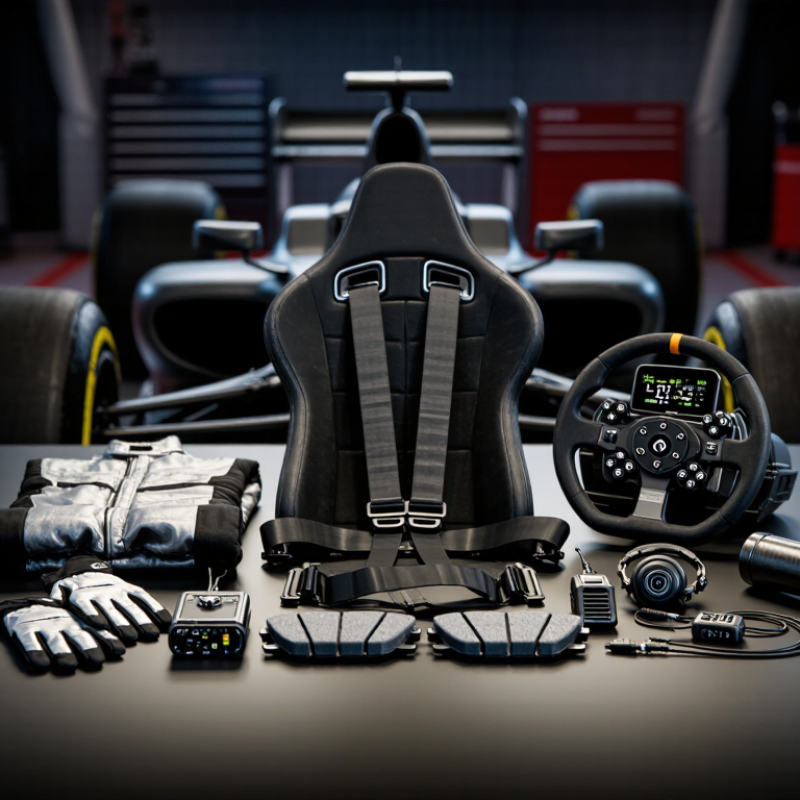
Top 10 Types of Motor Sports Racing Equipment?

Racing Equipment Categories and Their Core Functions

Top 10 Types of Motor Sports Racing Equipment

Racing equipment falls into ten practical categories, each protecting a different risk area. Helmets manage impact and fire exposure. Racing suits, underwear, gloves, and boots resist heat and abrasion. The FIA 8856-2018 standard uses an 11-second flame-resistance benchmark for approved protective clothing. That number sounds brief, but it can provide critical escape time. Seats and six-point harnesses stabilize the driver during sudden deceleration. Roll cages protect the survival space. Fire-suppression systems control flames before they spread. Neck restraints reduce dangerous head movement. Communication systems support clear pit-to-driver instructions. Data loggers record speed, braking, temperature, and impact loads.

Core functions should guide purchasing decisions, not appearance. The FIA’s 2023 annual report highlights safety research, medical readiness, and technical regulation as continuing priorities. Its published technical standards also separate equipment by test purpose, reminding teams that no single product solves every hazard. A helmet cannot replace a restraint system. A cage cannot correct a loose harness. Small fitting errors matter. I have seen drivers check the equipment carefully, then ignore seat alignment or worn straps. That habit needs challenging. Data can reveal the weakness: excessive cockpit heat, late braking pressure, or repeated belt loading. Yet reports rarely show every real-world failure. Track experience still matters, and equipment choices should be reviewed after every serious impact.

Driver Protection Gear for Safety and Performance

Driver protection gear is the foundation of safe motor sports racing.

A helmet, fire-resistant suit, gloves, boots, and balaclava protect different parts of the body. The FIA’s Appendix L requires approved helmets, head restraints, and protective clothing in many international competitions.

FIA Institute research reports that head-and-neck restraints can reduce neck loads by about 68% during severe frontal impacts. That number is powerful, but equipment only works when fitted correctly.

A racing helmet should sit firmly without creating pressure points. The visor must provide a clear view through dust, rain, and changing light. A head-and-neck restraint needs compatible anchors and careful adjustment. Small gaps can matter.

The suit should overlap the gloves and boots, leaving no exposed skin at the wrists or ankles. FIA 8856-2018 materials are tested for heat resistance, but damaged stitching can reduce protection. Inspect every seam after hard use.

Comfort affects performance too. A tight collar may distract a driver during a long race. Loose gloves can reduce steering feedback. The Snell Foundation’s SA2020 standard uses demanding impact and fire tests, yet certification cannot correct poor sizing. Drivers should practice wearing the complete system before competition. I have seen safety checks focus on labels while ignoring fit. That habit deserves criticism. Protection is not a checklist; it is a working system around the driver.

Vehicle Control and Handling Equipment

Top 10 Types of Motor Sports Racing Equipment: Vehicle Control and Handling Equipment

Vehicle control depends on equipment that keeps driver inputs predictable. A properly adjusted steering system gives clear feedback through tight corners. Racing seats hold the torso firmly, reducing unwanted movement during braking. Harnesses support the driver, but fit matters more than appearance. Pedal assemblies should provide consistent spacing and smooth pressure. A small change can affect confidence. Suspension components also shape handling, controlling body roll, weight transfer, and tire contact.

Tips: Check steering joints, pedal fasteners, and harness mounting points before every session. Record tire pressures when cold and after driving. Compare the notes. A tire pyrometer can reveal uneven temperatures across the tread. Excess heat on one edge may indicate poor alignment or driving habits. Adjust one setting at a time. Otherwise, the result becomes difficult to understand.

Brake systems deserve close attention because control often disappears before speed does. Firm pedal feel, balanced brake bias, and clean fluid support repeatable stopping points. Adjustable dampers can improve stability, yet they may hide a basic alignment problem. That mistake is common. Drivers sometimes chase faster lap times with aggressive settings, while the car becomes nervous over bumps. Careful testing on the same circuit helps separate real improvement from temporary excitement. Inspect equipment again after contact with curbs or heavy braking. Safety equipment should meet applicable motorsport regulations and remain free from damage.

Top 10 Types of Motor Sports Racing Equipment: Vehicle Control and Handling

Comparative count of commonly adjustable setup variables associated with each racing equipment category.

Dampers, tires and wheels, steering systems, brakes, and springs typically offer the widest range of handling-related setup adjustments. The counts are a practical reference based on common race-car setup areas and can vary by vehicle class, regulations, and suspension design.

Communication, Data, and Navigation Systems

Top 10 Types of Motor Sports Racing Equipment?
Communication, Data, and Navigation Systems

Modern racing depends on clear information as much as engine power. Two-way radio systems connect drivers with engineers during fast, stressful laps. Helmet intercoms reduce outside noise and preserve short commands. Pit-board displays provide backup signals when radio quality drops. Timing transponders record lap performance with precise trackside detection. Small errors compound.

Data loggers capture engine temperature, brake pressure, steering input, and suspension movement. Telemetry systems send selected measurements to the pit wall in near real time. GPS units map racing lines, corner speeds, and braking points. Tire-pressure sensors reveal heat changes that drivers may not feel immediately. These systems need careful calibration, protected wiring, and secure mounting. A loose connector can create misleading data.

Navigation displays guide drivers through sector markers, flags, pit-lane limits, and changing track conditions. Compact cameras also support review after each session. Experienced crews compare electronic readings with driver feedback before adjusting the setup. Numbers are useful, but they are not always the full story. Sensor drift, signal blockage, or a tired driver can distort interpretation. I would never treat one unexplained reading as proof. Rechecking the installation often exposes a simpler problem. Safety alerts must remain clear, legal, and easy to understand at racing speed.

Top 10 Types of Motor Sports Racing Equipment? - Communication, Data, and Navigation Systems

No. Equipment Type Primary Purpose Typical Data or Communication Function Common Technical Characteristics Typical Users
1 Pit-to-Car Radio System Provides real-time voice communication between the driver and the race team. Two-way voice, push-to-talk control, channel management, and race-direction communication where permitted. Usually uses regulated VHF or UHF radio bands; performance depends on antenna placement, track terrain, and local radio rules. Drivers, race engineers, strategists, and pit crews.
2 Helmet Intercom and Audio System Delivers clear communication inside a high-noise cockpit or helmet. Microphone input, speaker output, noise reduction, radio integration, and driver alert tones. Designed for high sound-pressure environments; commonly includes shielded wiring, hearing protection, and hands-free connections. Drivers and pit-to-car communication teams.
3 Vehicle Telemetry System Sends vehicle status and performance information from the car to the pit area. Engine parameters, temperatures, pressures, speeds, fuel status, electrical measurements, and fault codes. May use encrypted radio or cellular links; data transmission is subject to series regulations and track coverage. Race engineers, data engineers, mechanics, and safety personnel.
4 Onboard Data Logger Records detailed vehicle and driver data for post-session analysis. Sensor channels, control inputs, lap markers, event flags, and synchronized time stamps. Sampling rates vary by channel; fast signals such as vibration may be recorded at several kilohertz, while slower temperatures use lower rates. Performance engineers, vehicle dynamics engineers, and technicians.
5 CAN Bus Data Interface Allows electronic control units and sensors to exchange vehicle data. Data from engine, gearbox, brakes, steering, power systems, and chassis controllers. Classical CAN commonly supports up to 1 Mbit/s; CAN FD can provide higher payload efficiency and faster data phases when allowed. Control-system engineers, electronics technicians, and data-acquisition teams.
6 GNSS/GPS Positioning Unit Determines vehicle position, speed, heading, and lap location. Latitude, longitude, altitude, ground speed, heading, lap timing references, and track mapping. Common update rates range from 1 to 20 Hz; accuracy is affected by satellite visibility, antenna location, multipath, and correction services. Race engineers, timing analysts, navigation crews, and broadcasters.
7 Inertial Measurement Unit Measures vehicle motion when satellite signals are weak or unavailable. Three-axis acceleration, angular rate, roll, pitch, yaw, and motion-based vehicle dynamics data. Usually combines accelerometers and gyroscopes; sampling rates commonly range from 100 Hz to 1,000 Hz or more. Vehicle dynamics engineers, control engineers, and data analysts.
8 Electronic Timing Transponder Identifies a vehicle and records its passage across timing points. Vehicle identity, lap time, sector time, position order, pit-lane time, and race classification. Works with trackside detection loops or timing antennas; official systems are controlled by the event organizer. Timing officials, race control, teams, commentators, and spectators.
9 Trackside Weather Station Monitors conditions that influence tire choice, grip, visibility, and race strategy. Air temperature, humidity, wind speed and direction, rainfall, atmospheric pressure, and track-surface temperature. Data is collected at fixed track locations and can be distributed to teams through timing or race-control networks. Race control, strategists, tire engineers, safety crews, and meteorological staff.
10 Pit-Wall Timing and Data Display Presents live race information so the team can make rapid decisions. Lap and sector times, gaps, position, tire status, pit windows, fuel estimates, warnings, and driver messages. Combines timing feeds, telemetry, radio information, and manually entered strategy data on rugged displays or control consoles. Race strategists, engineers, team managers, and pit-lane coordinators.

Pit Crew Tools and Trackside Support Equipment

Pit Crew Tools and Trackside Support Equipment

Motor sports racing depends on more than speed and driver skill. Reliable pit equipment keeps every service controlled, repeatable, and safer. A calibrated torque wrench confirms wheel fasteners without guesswork. Pneumatic wheel tools reduce service time, but they need clean air and regular inspection. Hydraulic jacks, wheel chocks, and sturdy work stands support stable vehicle movement.

Small details matter. Tire pressure gauges should be checked against a trusted reference before each event. Spare valves, gloves, lights, and replacement tool batteries belong in clearly labeled cases. Radios connect the crew with timing and engineering staff. Short messages prevent confusion near a running car.

Still, radio traffic can become crowded. We sometimes speak too quickly, which causes avoidable mistakes.

Trackside support also includes fire extinguishers, first-aid supplies, spill-control materials, and approved electrical protection. These items need visible locations and documented inspections. Weather changes can expose weak planning. Rain covers, cable ramps, and dry storage protect equipment and reduce trip hazards. Data systems help technicians monitor temperatures, pressures, and suspension behavior, although sensor readings can be misleading when calibration slips. No checklist is perfect. A missed battery check once delayed a practice run, despite careful preparation. Reviewing that failure improved our packing routine and made responsibilities clearer.

FAQS

What equipment helps a race vehicle handle predictably?

Steering systems, racing seats, harnesses, pedals, suspension, and brakes shape vehicle control. A firm seat keeps the torso steady during hard braking. Small adjustments can change driver confidence. We sometimes expect too much from one component.

What should be checked before each driving session?

Inspect steering joints, pedal fasteners, and harness mounting points. Check for looseness, damage, or unusual movement. Measure tire pressures when cold and after driving. Write both readings down. Notes reveal patterns better than memory.

How can tire temperature readings improve setup decisions?

A tire pyrometer shows temperature differences across the tread. One hot edge may suggest alignment issues or driving habits. Change only one setting at a time. Otherwise, the result becomes difficult to interpret. That discipline is easy to ignore.

Why are brakes and dampers important for handling?

Firm pedal feel and balanced brake bias support repeatable stopping points. Adjustable dampers can improve stability and control body movement. Aggressive settings may make the vehicle nervous over bumps. Test changes on the same circuit. Excitement is not proof.

What communication equipment supports drivers and crews?

Two-way radios and helmet intercoms carry short commands during stressful laps. Pit-board displays provide backup signals when radio quality drops. Keep messages brief near a moving vehicle. Crowded radio traffic causes mistakes. We sometimes speak too quickly.

What data systems are useful during a racing session?

Data loggers record temperatures, brake pressure, steering input, and suspension movement. Telemetry sends selected measurements to the pit area. GPS systems show racing lines, corner speeds, and braking points. Tire-pressure sensors reveal changes drivers may not feel. Numbers still need human judgment.

How should racing data and sensors be checked?

Secure wiring, connectors, sensors, and mounting points before use. Calibrate equipment carefully and inspect it after each session. Signal blockage or sensor drift can distort readings. Recheck one unexplained result before changing the setup. A loose connector may be the real problem.

Which pit tools and support supplies are essential?

Useful items include a calibrated torque wrench, pneumatic wheel tools, jacks, chocks, and work stands. Pack pressure gauges, spare valves, gloves, lights, and batteries in labeled cases. Keep fire extinguishers, first-aid supplies, spill-control materials, and approved electrical protection visible. Weather covers and cable ramps reduce damage and trip hazards.

How can teams improve trackside preparation?

Use a written checklist with named responsibilities. Inspect batteries, tools, cables, and protective equipment before departure. Store equipment dry and protect it from rain. No checklist is perfect. Review every delay and improve the routine. One missed battery check can stop practice.

Conclusion

Motor Sports Racing equipment can be divided into several essential categories, each designed to improve safety, control, efficiency, and performance on the track. Driver protection gear includes helmets, fire-resistant suits, gloves, shoes, head-and-neck support, and impact protection systems. Vehicle control and handling equipment covers braking components, steering systems, suspension tools, tire management devices, and aerodynamic adjustments that help drivers maintain stability and precision at high speeds.

Modern racing also depends on communication, data, and navigation systems. Radios, timing displays, telemetry sensors, cameras, and navigation tools allow drivers and teams to monitor conditions, analyze performance, and make informed decisions. In the pit area, crew members rely on wheel-changing tools, lifting equipment, tire-pressure gauges, fluid service tools, replacement parts, and organized trackside support supplies. Together, these equipment groups create a coordinated racing system that supports preparation, rapid response, driver protection, and consistent vehicle performance throughout an event.


Sophia

Sophia

Sophia is a dedicated marketing professional with an exceptional depth of knowledge about her company's products and services. With a keen understanding of market trends and customer needs, she crafts insightful blog posts that not only inform but also engage readers, enriching the company’s online......